
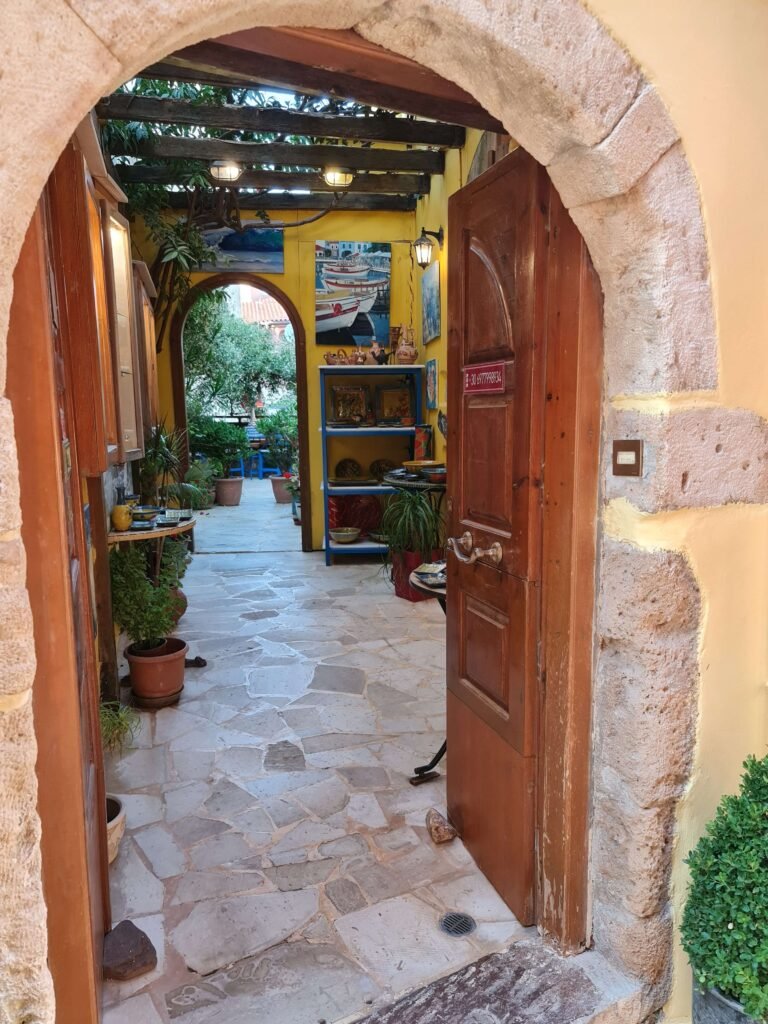
Chania’s Old Town is one of the most atmospheric places in all of Greece. Narrow lanes, Venetian mansions, Ottoman mosques, a crescent-shaped harbour — this is the Crete that stays with you long after you’ve gone home. This self-guided walking tour covers every highlight while steering you away from the tourist traps.
Getting to Chania Old Town
The Old Town sits just west of the modern city centre, easily reached on foot or by taxi. If you’re arriving from Heraklion, the KTEL bus drops you at the main station — a 10-minute walk away. From the harbour, most Old Town landmarks are within a 15-minute stroll of each other.
Start the tour in the morning (before 10:00) if you want the lanes largely to yourself. By midday in summer, the harbour area fills up quickly.
Stop 1: The Venetian Harbour
Begin at the iconic Venetian Harbour (Limani) — the unmistakable crescent of water framed by colourful waterfront buildings. The lighthouse at the far end of the breakwater dates from the 16th century (later rebuilt by the Egyptians) and is one of the most photographed spots on the island.
Walk the full length of the harbour wall — it takes about 20 minutes. You’ll pass fishing boats, sleek yachts, and open-air tavernas. Early morning is particularly magical: calm water, golden light, and almost no other tourists.
Stop 2: The Firkas Fortress and Maritime Museum
At the western end of the harbour stands the Firkas Fortress, built by the Venetians in 1629 to defend the harbour entrance. It was here that the Greek flag was raised over Crete for the first time on 1 December 1913, when the island was officially united with Greece.
Inside the fortress is the Maritime Museum of Crete, which traces 5,000 years of seafaring history. One of its highlights is a full-scale replica of a Minoan vessel. Entry costs around €3; allow 45 minutes.
Stop 3: The Mosque of the Janissaries
Back on the harbour, the large domed building with arched windows is the Mosque of the Janissaries (Tzami ton Gianitsaron). Built in 1645, immediately after the Ottoman conquest of Chania, it is the oldest Ottoman structure on Crete. Today it functions as a temporary exhibition space — check what’s on during your visit. Entry is free.
Stop 4: The Kasteli District
Head uphill from the mosque into Kasteli, the oldest inhabited quarter of Chania, built on the site of the ancient Minoan city of Kydonia. Archaeologists are still uncovering Minoan remains beneath modern buildings here — you may see excavation trenches through iron fences as you walk.
The views back over the harbour from the upper lanes of Kasteli are outstanding. Stop at one of the small cafes for a Greek coffee and take it all in.
Stop 5: Splantzia Square
A few minutes’ walk east of Kasteli brings you to Splantzia Square (Plateia 1821), one of the most charming spots in all of Chania. A large plane tree provides shade; the 14th-century church of Agios Nikolaos — which was converted into a mosque during the Ottoman period and back again — dominates the square.
This is a great place for breakfast. The small cafes around the square serve excellent local pies (spanakopita, bougatsa) and decent coffee without the harbour price premium.
Stop 6: The Jewish Quarter (Evraiki)
The narrow lanes east of the harbour make up what was once Chania’s thriving Jewish Quarter. Look for the Etz Hayyim Synagogue on Parodos Kondylaki — founded in the 15th century, it is one of the oldest active synagogues in Europe. The community that worshipped here was almost entirely deported and murdered during the Nazi occupation; the synagogue was restored in the 1990s and is open to visitors (free, Mon–Thu mornings).
Stop 7: The Covered Market (Agora)
Exit the Old Town through the Municipal Market (Agora), a beautiful cross-shaped covered market built in 1913 modelled on the market in Marseille. Inside you’ll find butchers, cheese sellers, herb vendors, honey producers, and small tavernas. Buy local graviera cheese, wild thyme honey, and Cretan raki (tsikoudia) here — the quality is excellent and the prices are reasonable.
This is also the best spot for a late morning snack: the tavernas at the centre of the market serve traditional Cretan food at lunch prices all day.
Practical Tips for Your Walking Tour
- Duration: Allow 3–4 hours for this tour at a relaxed pace.
- Footwear: The cobblestones are uneven — wear comfortable, flat shoes.
- Best time: Early morning (8:00–10:00) or late afternoon (17:00–19:00) for softer light and fewer crowds.
- Parking: Do not try to drive into the Old Town. Park outside and walk in.
- Guided tours: A local guide can unlock stories and hidden courtyards you’d never find on your own. 105Olives offers private guided tours of Chania with expert local guides.
Where to Eat in Chania Old Town
For lunch after the tour, walk five minutes west of the harbour to the neighbourhood of Koum Kapi. The seafront tavernas here are far less touristy than the harbour restaurants, the fish is fresher, and the prices are noticeably lower. Order whatever fish the kitchen bought that morning — you won’t go wrong.
For dinner, the lanes around Splantzia Square hold some of the best creative Cretan restaurants on the island — places run by young Cretan chefs who take traditional ingredients seriously.
Getting a Private Tour of Chania
If you want to go deeper than a self-guided walk, 105Olives arranges fully private, customised tours of Chania with expert local guides. A private tour can include the Old Town, the Akrotiri peninsula, local villages, olive oil producers, and mountain excursions — tailored entirely to your interests and pace. Contact us to plan your perfect Chania day.
