
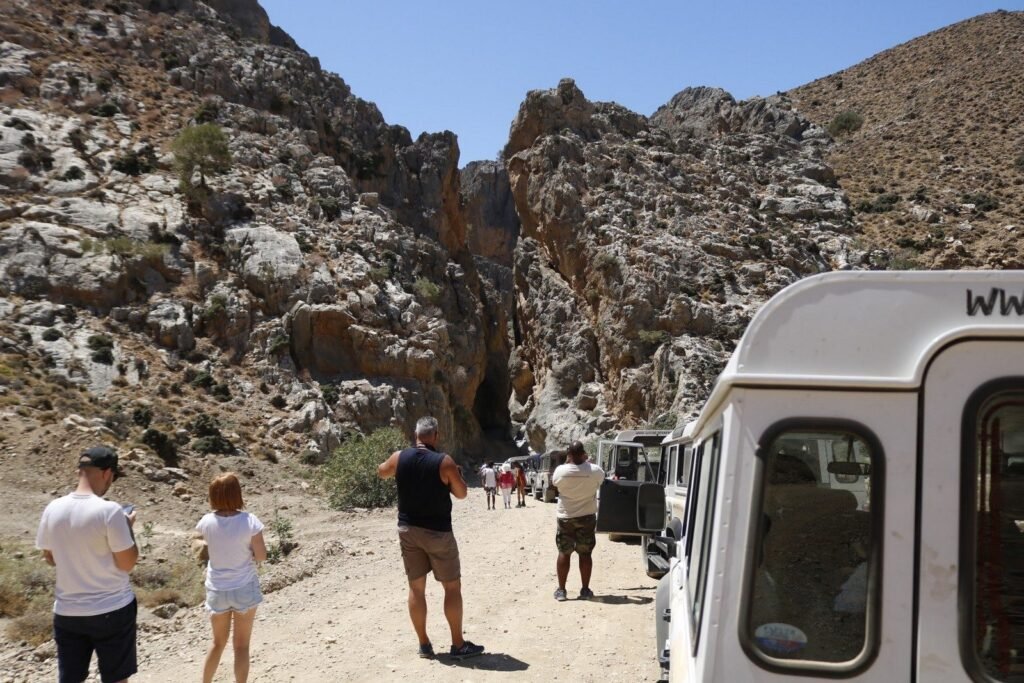
The Samaria Gorge hike is one of Europe’s great walking experiences — 16 km through a dramatic canyon carved over millennia, ending at a remote beach on Crete’s southern coast. This guide covers everything you need to plan a successful trek.
Essential Facts
- Distance: 16 km (top to bottom; there is no easy return by foot)
- Descent: 1,250 metres
- Duration: 4–7 hours depending on pace and fitness
- Difficulty: Moderate (the steep section is at the start; the rest is relatively flat)
- Open: Early May to late October (closed in winter due to flooding risk)
- Entry fee: €5 per person
- Gorge closes daily: Gates close at 15:00; plan to start no later than 13:00
The Route
The hike is one-directional: you start at Xyloskalo (at 1,230m elevation) and descend to Agia Roumeli on the Libyan Sea. There is no practical way to walk back — the return is by boat.
Xyloskalo to the Gorge Floor (first 3 km)
The first section is the hardest: a zig-zag descent of around 600m in 3 km down a well-maintained stone path. Take it slowly. This is where the views are most dramatic — the gorge opens below you and the White Mountains (Lefka Ori) rise above.
Through the Gorge (km 3–13)
Once on the gorge floor, the path follows the river bed — sometimes crossing it on wooden footbridges. The terrain is relatively gentle. The walls rise up to 300m on either side. In several places the gorge narrows to just a few metres: the most famous narrows, the Iron Gates (Sideroportes) at km 12, are only 3–4m wide.
Stop at the abandoned village of Samaria (km 7–8) for water and shade. There are several rest stations with water taps and toilets along the route.
Agia Roumeli (km 13–16)
After the Iron Gates, the gorge widens and the path becomes a paved track through an ancient olive grove. The last 3 km to the coast feel long after a full day’s walking — stay hydrated and don’t rush. The beach at Agia Roumeli is your reward: a beautiful stretch of pebbles and clear water where you can swim before catching the ferry.
Getting There and Back
This is the most important logistics point of the hike, and where many first-timers get confused.
Getting to Xyloskalo (start point)
Xyloskalo is in the Omalos plateau, about 1 hour south of Chania by car or bus. KTEL buses run from Chania Bus Station to Xyloskalo from May to October, with early morning departures timed for the hike. Check current timetables — the first bus is usually around 07:30.
Many visitors join organised tours from Chania or Heraklion that include bus transfer to the start point.
Return from Agia Roumeli
There is no road to Agia Roumeli — the only exit is by boat. Ferries run from Agia Roumeli to Sougia (west) and Hora Sfakion (east) several times daily from May to October. Most hikers take the ferry to Hora Sfakion and then a KTEL bus back to Chania or Heraklion.
Last ferries depart around 17:30–18:00 — check the current schedule and don’t miss them. Book return bus tickets in advance in peak season.
Alternative: If you’re joining a private guided tour with 105Olives, we handle all the logistics — transfer to Xyloskalo, ferry, and return bus — so you can focus entirely on the hike.
What to Pack
- Water: Minimum 2 litres; 3 litres in summer. There are water taps in the gorge but don’t rely on them entirely.
- Food: Pack lunch and snacks. The gorge has no food vendors inside.
- Footwear: Proper hiking shoes or sturdy trainers with grip. The river crossings can be slippery.
- Sun protection: Hat, sunscreen, sunglasses. The lower gorge is exposed.
- Swimwear: Pack it for the beach at Agia Roumeli — you’ve earned a swim.
- Layers: The upper gorge at Xyloskalo can be cold even in summer. Bring a light jacket.
- Walking poles: Helpful for the steep descent at the start.
When to Go
Best months: May, June, and September. July and August are hot (the gorge funnels heat), very crowded, and the river may be completely dry. Spring (May) is the most beautiful — wildflowers, waterfalls, and cool temperatures.
Avoid the peak season if you can; in July–August the gorge can hold 3,000+ hikers daily.
Tips for an Enjoyable Hike
- Start early — the first hour of the descent is in shade, which makes it much more pleasant.
- Take your time on the rocky sections; ankle injuries are the most common mishap.
- The gorge rangers are stationed at several points — they will help if needed.
- Do not enter the gorge after the 15:00 gate closure.
- Dogs are not permitted in the gorge.
Private Guided Samaria Gorge Tours
105Olives organises fully private Samaria Gorge hikes with an expert local guide, all logistics included. We pick you up from your hotel, drive you to Xyloskalo, accompany you through the gorge, and return you to your accommodation — with all ferry and bus arrangements handled. Enquire about a private Samaria tour.
Samaria Gorge: Complete Practical Information 2026
| Detail | Information |
|---|---|
| Season | Typically April 15 – October 31 (depends on annual conditions) |
| Distance | 16 km (standard north to south route) |
| Descent | 1,230 metres (trailhead) to sea level |
| Duration | 4–7 hours depending on fitness and pace |
| Entrance fee | €5 (adult) | €2.50 (reduced) | Under 15: free |
| Opening time | Gates open 07:00 | Must enter before 16:00 (closing time varies) |
| Trailhead access | Xyloskalo, 44 km south of Chania. Bus from Chania (KTEL) or private vehicle |
| End point | Agia Roumeli village (sea level). Ferry to Sfakia, then bus/taxi to Chania |
| Difficulty | Moderate (rocky path, descent required). Fit walkers of any age manage comfortably |
Flora and Wildlife of the Samaria Gorge
The gorge cuts through the White Mountains National Park — one of the most botanically rich protected areas in Europe. Walking with a guide who knows the plants transforms a strenuous hike into a field course. Notable species:
- Cretan ebony (Ebenus cretica) — endemic to Crete, pink-flowered, grows in the gorge walls. Blooms April–June.
- Wild peonies — large-flowered, grow among the rocks. Visible May–June.
- Cretan wild goat (Kri-Kri / Capra aegagrus cretensis) — endemic to Crete, protected. Often visible on the gorge walls in early morning. Distinguished from ordinary goats by horizontal horns and distinctive colouring.
- Griffon vultures — large colonies nest in the gorge walls. Common overhead, particularly in the upper section.
The Iron Gates (Sideroportes)
At kilometre 12, the gorge narrows to just 3–4 metres wide. The walls rise to 300 metres on each side. You walk through a slot of rock that the sea once cut, the river now trickles through, and the light barely penetrates at midday. This is the defining moment of the gorge — the photograph that does not do it justice and the experience that does. It takes about 45 seconds to walk through; most hikers stop and look upward for several minutes.
After the Gorge: Agia Roumeli and the Return
The gorge exits at Agia Roumeli, a tiny village accessible only by sea or on foot. The first thing most hikers do is jump in the Libyan Sea at the village beach — the water is clear, cool, and the relief is immediate. The village has several tavernas, cold drinks, and the specific pleasure of sitting down after 16 km of rocky descent.
The return is by ferry to Sfakia (30 minutes, €12 per person) and then by KTEL bus to Chania (1 hour, €7). If you booked with a private guide, they handle all ferry and bus tickets and accompany you the full way back. If you went independently, confirm the last ferry time before you start the hike.
Frequently Asked Questions
Is the Samaria Gorge hike difficult?
Moderate. The challenge is not the distance (16 km) but the descent in the first 6 km (1,230 metres drop) on a rocky path. Trekking poles significantly reduce knee strain on the descent. The remaining 10 km is flat along the riverbed. Most reasonably fit adults with good footwear complete it comfortably. We recommend it for ages 10 and above.
Can I do the Samaria Gorge hike without a guide?
Yes — it is well-marked and managed by the forest service. However, a guide adds botanical and geological context, carries emergency supplies, and handles all logistics (ferry tickets, return transport). If you want to focus on the experience rather than the administration, a private guide is worthwhile.
What should I wear and bring?
Sturdy walking shoes or hiking boots (essential — not sandals or trainers). 2 litres of water (springs en route supplement this). Sun protection. Light rain layer (morning weather can change at altitude). Trekking poles if you have knee issues. Light snack — there is nowhere to buy food inside the gorge.
Book a Guided Samaria Gorge Hike — WhatsApp
