
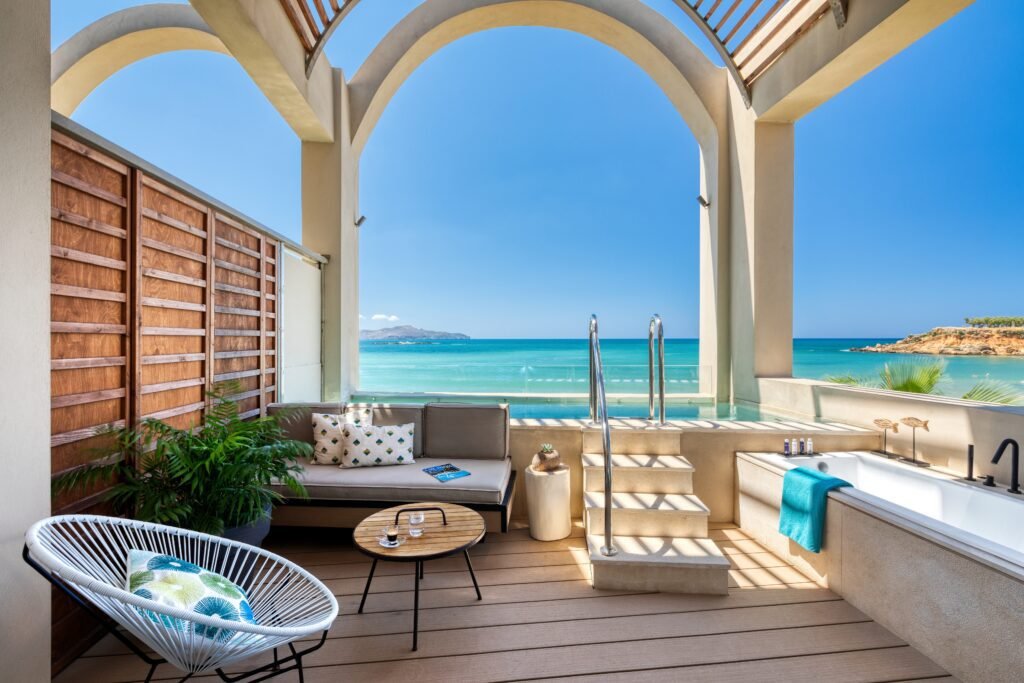
Crete’s luxury hotels have undergone a quiet revolution. Beyond the sprawling beach resorts, a new generation of boutique properties—many with just 8–15 rooms, infinity pools carved into cliffsides, and Michelin-adjacent kitchens—are redefining what a Greek island escape means. If you’ve spent your previous Crete holidays in predictable four-star chains, the intimate, design-led sanctuaries waiting in villages like Anogia, PLakias, and the Venetian harbours of Rethymno will feel like stepping into another world entirely.
Want a quick answer? Message us on WhatsApp or fill in our trip-planning form — we reply the same day.
Why Crete’s Luxury Boutique Hotels Are Worth the Hype in 2026
Crete has never been fashionable in the way Santorini or Mykonos are—and that is precisely why luxury travellers with genuine taste are choosing it now. While the Greek islands compete on Instagram aesthetics, Crete competes on authenticity, substance, and genuine hospitality. The island’s three main regions—Chania, Rethymno, and Heraklion—span roughly 260 kilometres from west to east, each with distinct character. The western coast around Chania and the Samaria Gorge attracts active, culturally minded guests; the central north shore, particularly the Venetian town of Rethymno (just 52 kilometres east of Chania), draws design enthusiasts and couples; the southern coast, with villages like Plakias and Matala, offers dramatic isolation and clifftop serenity.
What separates Crete’s emerging luxury boutique scene from cookie-cutter five-star chains is the philosophy underlying each property. Rather than replicating the formula of marble lobbies and conference facilities, Crete’s most celebrated new openings—places like Daios Cove (near Agios Nikolaos, 70 kilometres east of Heraklion) and the minimalist Marpunta Villas in Panormo—are built by families or design collectives who’ve chosen to live on the island themselves. They understand Cretan wine, Cretan olive oil, Cretan architecture from the Venetian and Ottoman periods. Breakfast is not a buffet but an argument between the chef about whether today’s loukoumades should be served with thyme honey or Mastiha syrup. This level of obsessive detail is what you’re paying premium rates for, not thread count or spa square footage.
The timing for a 2026 visit is particularly shrewd. Crete’s luxury sector is still in what urban planners call the ‘early majority’ phase—enough properties have opened to offer genuine choice and competition, but the island hasn’t yet become overrun with luxury tourism in the way Santorini has. A five-star suite in a clifftop hotel in Rethymno runs €180–240 per night in high season; equivalent accommodation in Santorini’s Oia costs €400–600. This 50–60% price difference exists not because Crete is inferior, but because the island’s geography and lack of cruise-ship focus have kept it quieter. By 2026, as more international luxury guides feature Crete properties, demand will intensify and prices will follow.
Geography also works in Crete’s favour for travellers who want both luxury and activity. The island is large enough that it functions like a mini-continent: you can wake in a clifftop suite above turquoise Libyan Sea water, spend your afternoon exploring Minoan ruins at Phaistos (65 kilometres away, roughly 90 minutes’ drive), have dinner at a family-run taverna in a mountain village where your hotel owner’s grandmother was born, and be back for sunset wine on your terrace by 8 p.m. Few Mediterranean luxury destinations offer this combination of isolation and cultural accessibility.
The Best Boutique Hotels and Private Villas: Where to Stay in 2026
Adults-Only Clifftop Retreats on the North Coast
The stretch of northern coastline between Chania and Rethymno contains some of the Mediterranean’s most underrated luxury properties. Daios Cove, a 65-room adults-only resort near the quieter beach town of Agios Nikolaos (roughly 90 minutes from Chania by car), has become the quiet favourite of design-conscious travellers and honeymooners who’d otherwise book Cap Rocat in Mallorca or similar Balearic properties. What makes Daios distinctive is not scale but integration: every suite either opens directly onto a private beach cove or cantilevers over cliff-edge pools; the restaurant sources ingredients from Cretan producers within 40 kilometres; the spa uses olive-oil-based treatments from a family producer in the Rethymno foothills. A junior suite runs €240–280 per night in summer, a private villa suite with plunge pool reaches €400–500. The property hosts no conferences, weddings, or tour groups—intentionally. You will see the same 40 guests at breakfast every morning, and by your second or third visit (many guests return annually), you’ll be greeted by name.
If Daios feels too established, Marpunta Villas in Panormo village (28 kilometres east of Rethymno, a 35-minute drive on the coastal road) offers a smaller-scale alternative. Eight suites and four standalone villas arranged across a Venetian estate that the owners—a German architect couple and their Cretan business partner—spent four years restoring. Unlike properties that advertise ‘authentic Cretan charm’ while serving international fusion cuisine, Marpunta’s menu is uncompromising: it changes daily based on what’s been bought at the Rethymno market that morning, and the chef (formerly at Michelin-starred Alinea in Chicago) trained under a 73-year-old Cretan woman who taught him to make horta (boiled greens) properly. Rooms start at €160 per night in shoulder season (April–May, September–October); peak summer suites with private pools cost €280–320. The property’s philosophy is explicitly low-key: no spa, no activities desk, no Instagram-bait décor. You get a kitchen-table breakfast, a pool that’s never crowded, and staff who know the best unvisited beaches because they actually live in Panormo.
For travellers interested in pairing luxury accommodation with Crete private tours of archaeological sites, villages, and food experiences, this northern coast location is ideal. It places you within 45 minutes of the Venetian Old Town in Rethymno (40 kilometres of winding mountain roads and coastal hairpins), 90 minutes from Chania’s Kastelli district and waterfront, and 120 minutes from the Samaria Gorge National Park. You’re also perfectly positioned to visit inland mountain villages like Anogia (1 hour away), famous for weaving and traditional music, where your hotel can arrange a private cooking class in a family kitchen for €85–120 per person.
Mythos Suites, perched above the fishing village of Bali (25 kilometres west of Rethymno), is a 22-room property that splits the difference between Daios’s scale and Marpunta’s intimacy. Each suite has a sea-view balcony and an indoor rain shower; the restaurant serves modern Mediterranean food with Cretan foundations (fresh fish daily, slow-roasted Cretan lamb); the pool is heated year-round. Rates: €145–185 per night in low season, €220–260 in high summer. The draw here is location: Bali is an active fishing village with genuine character (not a manicured resort town), so you can walk 100 metres down to the harbour for dinner at Taverna Kostas, where the same family has cooked fish for three generations, or you can dine on your terrace. Many guests spend half their holiday at the hotel and half exploring: Rethymno Old Town is 25 kilometres away, the Cretan wine region of Archanes is 60 kilometres south.
Private Pool Villas and Estate Stays in the Rethymno Hinterland
If you’re travelling as a family, with friends, or seeking genuine seclusion, the inland villages and agricultural estates surrounding Rethymno offer something the coastal hotels cannot: privacy, land, and the feeling of renting a Cretan family’s ancestral home. Villa Petalo, a collection of three newly renovated stone manor houses in the village of Elos (50 kilometres south of Rethymno, in the foothills above the Libyan Sea), offers the most luxurious self-catering option on the island. Each villa has 3–4 bedrooms, a private infinity pool overlooking terraced olive groves, a wood-fired sauna, and an outdoor kitchen where you can cook with ingredients from the property’s own garden. Prices: €1,800–2,200 per week in low season, €3,200–3,800 in peak summer. If you want daily staff, a private chef can be arranged for €450–550 per day (typically 4–5 hours, lunch and dinner included). The nearest restaurant is 5 kilometres away, but the village of Elos itself (population 180, elevation 450 metres) has a single taverna and a kafeneio, and the owners can arrange foraging walks, beekeeping experiences, and visits to local wine producers.
For those who want luxury hotel service without the buzz of other guests, Angelica Villas near the village of Panormo (35 kilometres east of Rethymno) operates five detached stone villas, each with its own private pool, hammam, and land. Rates: €250–320 per night for a four-bedroom villa in high season. The property includes daily cleaning, breakfast delivered to your villa, and on-demand chef services. The selling point is solitude: each villa is separated from others by olive groves and stone walls, and the property employs a local driver (€60 per hour) if you want guided exploration without navigating Cretan mountain roads yourself.
Harbour-View Charm: Venetian Rethymno and Chania’s Old Towns
For guests who want luxury accommodation in a living, breathing town (rather than an isolated resort), Rethymno’s Old Town offers something genuinely rare in Greece: a Venetian harbour district that’s been inhabited continuously since 1204 and genuinely functions as a local neighbourhood, not a tourist theme park. Hotel Caramella, a 13-room property housed in a restored Venetian palace on the harbour-front (GPS: 35.3637° N, 25.0332° E), offers rooms starting at €120 per night in low season, €200–240 in summer. The advantage is immersion: you’re literally above the fishing fleet; locals still shop at the covered market two streets back; the waterfront tavernas serve food for Cretan families, not tour groups. Breakfast is served in a ground-floor salon with original Venetian stone work; the owner, Giorgos, can recommend restaurants that won’t appear in any guidebook, because he eats at them himself.
In Chania (the island’s largest city, 52 kilometres west of Rethymno), the luxury options are more abundant but also more commercialised. Palazzo Rimondi, another restored Venetian property, offers 29 rooms and a central courtyard pool; rates €150–200 per night. It’s larger than Caramella and benefits from Chania’s wider restaurant scene (the city has perhaps six restaurants operating at Michelin-level seriousness), but you lose some of the intimacy. If you want Chania with absolute top-tier service, Aquila Elounda, a 62-room property in the beach town of Elounda (45 kilometres east of Chania, 70 kilometres from Rethymno), commands €280–350 per night for suites but includes helicopter airport transfer, private beach access, and a Michelin-trained kitchen that sources ingredients from a network of local producers the owners have spent years cultivating.
Signature Experiences at Crete’s Best Hotels: Dining, Spa, and Local Connection
What distinguishes luxury travel in Crete from luxury travel in other Mediterranean destinations is the ease with which you can step directly from your suite into genuine, lived-in Cretan culture. Daios Cove, for example, doesn’t position itself as an ‘all-inclusive’; instead, it offers guests a complimentary daily jeep excursion to a working family olive farm in the Lasithi Plateau (1,000 metres elevation, roughly 90 minutes’ drive), where you’ll harvest olives (in season: November–January) or learn about the production process, then eat lunch with the family—genuinely, in their kitchen, not at a set table for tourists. This isn’t offered as an ‘activity package’ (€120 per person); it’s included for all guests because the owners believe it’s what separates a luxury experience from a luxury stay.
At Marpunta Villas, the signature offering is the Friday-night village dinner. Because the property sits in Panormo proper, the owner arranges a long table under the stars in the village square, and villagers—the baker, the taverna owner, the retired schoolteacher—join guests for a communal dinner where wine flows, stories accumulate, and by midnight, someone’s playing Cretan lyra (a traditional three-stringed instrument). This costs €55–75 per person and is genuinely spontaneous; there’s no script, no entertainment agenda, just conversation and food. Guests often report this as the most memorable night of their holiday.
Spa and wellness facilities at Crete’s best boutique hotels reflect the island’s agricultural and healing traditions rather than copying international luxury-spa templates. Mythos Suites’ spa treatments are based on olive oil, Cretan wine (red wine contains resveratrol, which is used in anti-ageing facials), and wild herbs foraged from the island’s interior. A 60-minute ‘Cretan Olive Ritual’ facial costs €95; a 90-minute full-body massage with wine-infused oils is €140. The spa therapists—most trained at the Ananda Spa Institute in India but practising in Crete for 5–8 years—understand the island’s healing traditions in depth. Similarly, Angelica Villas includes a traditional hammam (Turkish steam bath) at each villa, and for €65 per person, a local healer offers traditional Cretan massage using warming oils from olive and sesame.
Dining experiences at the best properties are never generic. Daios Cove’s restaurant, Aggregate, sources ingredients within a 40-kilometre radius and features a different Cretan village or farm each week; one week it might be the goat-cheese producer near Chania, the next week the organic vegetable grower in the Messara Plain. The €45–65 fixed menu changes completely each night. Marpunta’s daily-changing menu (€35–50 per person) is hand-written each morning based on the chef’s market visits; you might have fresh grouper three nights running, but prepared entirely differently each time. At Mythos Suites, the kitchen focuses on slow-roasted and wood-fired techniques, and the owner personally selects wines from small Cretan producers; the wine list features 30+ selections from producers making fewer than 10,000 bottles annually.
Crete’s Luxury Hotel Regions: How to Choose Based on Your Travel Style
| Region | Best For | Key Towns | Distance from Chania | Sample Property | Price Range (€/night) |
|---|---|---|---|---|---|
| Western (Chania) | Mountain hiking, Samaria Gorge, food culture, Venetian architecture | Chania, Kastelli, Paleochora | 0 km (baseline) | Palazzo Rimondi, Aquila Elounda | €150–350 |
| Central (Rethymno) | Wine tasting, Venetian towns, clifftop seclusion, balancing culture and relaxation | Rethymno, Bali, Panormo, Anogia | 52 km (1 hour) | Marpunta Villas, Caramella Hotel | €120–280 |
| Eastern (Agios Nikolaos, Elounda) | Adults-only relaxation, Minoan archaeology (Malia, Phaistos), quieter beaches | Agios Nikolaos, Elounda, Malia | 90 km (1.5 hours) | Daios Cove, Aquila Elounda | €240–400 |
| South Coast (Plakias, Matala) | Dramatic isolation, beaches, hiking via the E4 trail, minimal tourism | Plakias, Matala, Myrthios | 80–120 km (1.5–2 hours) | Luxury villa estates, fewer established hotels | €140–220 |
| Inland (Anogia, Archanes) | Wine, olive oil, weaving, mountain villages, food immersion | Anogia, Archanes, Elos | 50–80 km (1–1.5 hours) | Villa Petalo, Angelica Villas (private estates) | €180–320 (villas) |
Practical Information: Getting to Crete and Timing Your Luxury Stay
Most international visitors arrive at Nikos Kazantzakis International Airport near Heraklion (the island’s capital, population 140,000), located 4 kilometres south of the city centre. From the airport, the western boutique hotels—Marpunta Villas in Panormo, Mythos Suites in Bali, and properties in Rethymno—are 70–100 kilometres away, requiring 90–120 minutes’ drive depending on traffic. The eastern properties (Daios Cove near Agios Nikolaos) are 70 kilometres away, approximately 90 minutes. All 105 Olives Greece clients receive complimentary private airport transfers; for independent travellers, a private car service costs €90–120 one-way, or you can rent a car for €45–60 daily. The drive west from the airport towards Rethymno and Chania follows the northern coastal road (Old Road E75), which is genuinely scenic; allow yourself an extra 30 minutes if you’re not accustomed to Greek road conditions (narrow lanes, occasional hairpins, but generally good asphalt).
Timing matters significantly for Crete’s luxury season. April to June and September to October are genuinely optimal: Mediterranean weather (25–28°C), active but not overwhelming tourism, and Greek hospitality at its most generous (staff aren’t burned out from July–August). High summer (July–August) brings temperatures of 30–33°C, intense sun, package tourists on beaches, and full prices without the exclusive atmosphere. November to March is genuinely quiet—many boutique hotels reduce staff and some close entirely—but December, January, and February offer solitude, lower prices (€100–160 per night at five-star properties), and the genuine possibility of snow in mountain villages like Anogia. Autumn (September–October) is perhaps the most underrated time: Cretan wine harvest occurs in September, villages are alive with activity, swimming is still warm (water temperature 26°C in early September, 24°C by October), and prices are 20–30% lower than peak summer.
The Cretan holiday calendar matters if you’re visiting in summer. Orthodox Easter (often different from Western Easter; in 2026 it falls on 5 May) sees hotels fully booked and prices at absolute peak; if you can travel the week immediately after Easter, you’ll find more availability and slightly lower rates. August is peak European holiday season, so booking any luxury property for mid-August 2026 requires reservations made by late 2025. Conversely, the two weeks following the Greek Orthodox Easter holiday see a sharp drop-off in demand, so 9–23 May 2026 offers luxury at near-peak-season standards but with significantly more availability.
Getting Around Crete: Roads, Rental Cars, and Hiring Drivers
Crete has an extensive highway system, but driving on the island—particularly if you’re unfamiliar with Greek road culture and narrow mountain passes—can be challenging. The main E90 highway runs east–west along the north coast; it’s modern and relatively fast (allowing 70–100 km/hour), but secondary roads into mountain villages require patience and confidence with tight hairpins. If you’re renting a car (€45–70 per day from international companies), be aware that petrol costs approximately €1.70 per litre, and mountain roads can consume fuel quickly. Speed cameras operate on the E90 and main highways; fines are issued via rental car company records and can reach €200–300 if contested late. Most luxury hotel clients hire a driver instead: rates are €60–80 per hour, with typical daily arrangements costing €400–500 for an 8-hour day. Your hotel can arrange this, or 105 Olives Greece can pre-arrange professional drivers for your entire stay. Buses operate on major routes (Chania to Rethymno to Heraklion), with journeys costing €5–15, but they’re slow and inflexible for guests wanting to visit multiple villages in one day.
If you’re interested in combining luxury hotel stays with structured exploration, our multi-day tours from Crete include professional guides, private drivers, and curated experiences at family-owned restaurants and producers that aren’t accessible to independent travellers. A three-day itinerary covering Chania’s Old Town, mountain villages, and an olive oil producer typically costs €450–650 per person (excluding accommodation) and provides significantly more depth than self-directed tourism.
💬 Chat on WhatsApp — Plan Your Trip
Frequently Asked Questions
What is the best time to book a luxury Crete hotel for 2026?
For peak summer availability (July–August), book by February–March 2026; for May–June and September–October (optimal weather and fewer crowds), booking two months in advance is usually sufficient. Properties often offer 10–15% discounts for bookings made three months or more in advance. Our WhatsApp team can check availability and secure early-bird rates for you immediately.
Do Crete’s luxury boutique hotels accept children, or are they adults-only?
Most boutique properties accept families, though some—notably Daios Cove and certain suites at higher-end resorts—are explicitly adults-only (18+) to maintain tranquillity. Properties like Marpunta Villas, Angelica Villas, and Villa Petalo actively welcome families and can arrange childcare, cooking classes for teenagers, and family-friendly activities. Always confirm child policies before booking, as they vary significantly by property and season.
Are meals included at Crete’s boutique luxury hotels, or do you pay à la carte?
Almost all boutique properties operate on a room-only or bed-and-breakfast basis; meals are available but not mandatory. This differs from all-inclusive resorts and allows flexibility to dine at village tavernas or arrange private chef experiences. Budget €35–65 per person for dinner at the hotel restaurant, €15–35 at local village tavernas, and €450–550 per day for private chef services at villas.
Can luxury hotels in Crete arrange activities like cooking classes, wine tours, or hiking?
Yes—all established boutique properties have relationships with local producers, guides, and experience organisers. Typical arrangements include cooking classes (€75–120 per person), wine tastings at producer estates (€45–85), Cretan weaving workshops (€55–95), and guided hiking to the Samaria Gorge (€120–180 including transport, breakfast, and guide). These are usually booked through your hotel concierge and cost separately from room rates.
What is the cancellation policy for booking luxury hotels in Crete, and what happens if I need to change my dates?
Standard cancellation policies allow free cancellation up to 30–45 days before arrival; cancellations within 14 days typically forfeit 50% of the booking, and cancellations within 7 days forfeit the full amount. Many properties offer flexible rates (10–15% cheaper) with non-refundable conditions; stricter cancellation policies might be waived if you book through a specialist travel partner like 105 Olives Greece, who can sometimes negotiate on your behalf.
Insider Secrets: What Luxury Travellers to Crete Actually Do (That Guidebooks Don’t Mention)
The most discerning Crete hotel guests don’t spend their days lounging by the property pool. Instead, they use the hotel as a home base and venture inland during early morning hours (before heat and crowds) to experience what makes Crete genuinely different from other Mediterranean islands. A private ritual involves hiring a car or driver the evening before, then driving to a mountain village like Anogia (population 2,000, elevation 700 metres) at 8 a.m., when the village kafeneio is full of locals playing backgammon and drinking mountain tea. You’ll sit with these men—they’ll initially ignore you, then gradually include you in conversation—and by 10 a.m., someone will insist on showing you their daughter’s weaving workshop or their family’s olive groves. This costs nothing and is infinitely more memorable than any ‘arranged cultural experience’.
Another insider move: ask your hotel to book you a table (not a ‘reservation’, but actually speak to the owner by phone) at Taverna Paleokastro in the village of Vamos (30 kilometres east of Rethymno), which serves food exclusively from ingredients grown or raised within 5 kilometres. The chef, Michalis, is the village school’s former headmaster and cooks one menu per night based on what’s at market; you sit at a long communal table, wine costs €8–12 per bottle, and meals run €25–35 per person. This taverna won’t appear in Michelin guides, but it’s where Crete’s most serious food travellers eat. Similarly, the wine producer Lyrarakis Winery (near Archanes, 60 kilometres south of Heraklion) produces some of Greece’s most respected wines with minimal international marketing; a cellar visit and tasting costs €45 per person, and the owner will spend three hours discussing soil, terroir, and ancient Minoan winemaking if you show genuine interest.
For beach access without the crowds, few luxury guests know about Ammoudaki Beach near Plakias (140 kilometres south of Heraklion, roughly 2 hours’ drive), a 2-kilometre stretch of sand that remains virtually empty even in August because it requires a 20-minute walk from the carpark. Similarly, the beach at Preveli (100 kilometres south of Heraklion), where a river meets the sea and palm trees grow at sea level, is quieter than tourist-oriented Matala because it’s less signposted and requires a 15-minute coastal walk. Your boutique hotel can arrange a private picnic basket to be delivered to either beach; many guests regard this as the secret highlight of their Crete stay.
Finally, the most sophisticated luxury travellers stay at boutique hotels not for the amenities, but to gain insider access to Cretan food and wine networks. Ask your hotel owner for an introduction to a local vineyard, olive oil producer, or honey farmer; these people rarely advertise, and visits must be arranged personally. A morning at a family-run vineyard like Douloufakis (near Heraklion, producing biodynamic wines since 1999) involves harvest participation (in September–October), barrel tastings, and lunch with the family—€120–150 per person—and you’ll form genuine friendships rather than collect tourist experiences.
Budget and Costs: What to Realistically Expect When Booking Luxury Hotels in Crete
Crete’s luxury hotel pricing is genuinely lower than other Mediterranean destinations, but it’s important to understand what drives costs and how to optimise your budget. A suite with sea views at an established boutique property runs €160–240 per night in shoulder season (April–May, September–October), rising to €240–340 in July–August. Private villas with pools increase this to €250–350 per night for a three-bedroom property. Adults-only resorts like Daios Cove run €240–400 depending on suite category and season. These rates are 40–50% lower than equivalent accommodation in Santorini, primarily because Crete hasn’t yet reached Santorini’s saturation of international tourism. However, this pricing advantage will compress by 2027–2028 as more international guides feature Crete properties, so booking for 2026 captures genuine value before prices climb.
Additional costs beyond room rates include meals (€35–65 per person at the hotel restaurant, €15–35 at village tavernas), activities and experiences (€45–180 per person depending on type: wine tastings are cheapest, private cooking classes or guided hiking most expensive), spa treatments (€65–140 per person), and private transfers or driver hire (€90–120 for airport transfer, €60–80 per hour for day-driver services). A realistic budget for a couple spending seven nights at a €200-per-night boutique hotel, including meals, one professional tour day, and light spa use, is €3,200–3,800 total (approximately €460–545 per person, per day). This includes all accommodation, meals, and activities, but not international flights or tips.
Smart budget optimisation: book boutique properties in May, early June, or September rather than July–August, where you’ll receive 20–30% lower nightly rates without sacrificing weather quality. Similarly, combining two nights at a luxury clifftop hotel with three nights at a private villa (typically €220–300 per night) allows you to experience both hotel service and self-catering independence while spreading costs. Finally, properties often offer 10–15% reductions for stays exceeding ten nights, and some provide free activities (olive farm visits, village dinners, cooking classes) when booking directly via 105 Olives Greece rather than through third-party booking sites.
| Experience Category | Budget Option | Mid-Range | Luxury | Best Value Season |
|---|---|---|---|---|
| Accommodation (per night) | €80–120 (3-star hotels) | €160–220 (boutique hotels) | €280–400 (adults-only resorts, private villas) | April–May, September–October |
| Breakfast | €8–12 (if not included) | Included at most boutique hotels | Included (often organic, farm-sourced) | Year-round stable pricing |
| Dinner (per person, restaurant) | €12–18 (village tavernas) | €25–40 (quality local restaurants) | €45–70 (hotel fine dining, private chef) | May–June (before peak tourism) |
| Wine (bottle, restaurant) | €8–15 (local house wine) | €20–45 (small-producer Cretan) | €50–120 (rare vintages, imported) | Pricing stable; September harvest season best for vineyard visits |
| Guided Activities (per person) | €40–70 (group tours, standard sites) | €85–150 (private guides, producer visits) | €180–350 (multi-day private tours, exclusive access) | May–June (lower rates, better availability) |
| Spa (60-minute massage) | €45–60 (standard chains) | €80–110 (olive-oil-based, Cretan traditions) | €120–160 (private villa services, bespoke treatments) | Year-round; package discounts available |
| Private Driver (8-hour day) | €45–60/hour (standard hire cars) | €400–500/day (professional drivers with local knowledge) | €600–800/day (guides with archaeological or culinary expertise) | May–September (best driving conditions) |
Combining Your Crete Luxury Hotel with Broader Greek Island Experiences
One advantage of basing yourself at a Crete luxury boutique hotel is the island’s accessibility to other Aegean islands. Ferries depart from Chania, Rethymno, and Heraklion daily to Santorini (2–3 hours, €25–35 passenger fare), Mykonos (5–6 hours), and Naxos (6–7 hours). Most luxury travellers avoid the crowded group ferries, instead arranging private yacht transfers through their hotel or a specialist operator. A private speedboat from Chania to Santorini’s Amoudi Bay (arriving in the quieter, less-touristy north) takes 90 minutes and costs €800–1,200 for up to eight passengers. If you’re interested in multi-island itineraries, our private yacht charter in Crete service allows you to base yourself on a luxury gulet (traditional wooden yacht), sleep on the boat, and visit 3–4 islands across a seven-day cruise with professional crew, chef, and guide. Costs run €3,500–5,500 per day depending on yacht category, with accommodation, all meals, and activities included.
Alternatively, day trips from your Crete hotel to nearby islands are genuinely feasible. A Santorini day trip from Crete involves an early ferry departure (typically 7–8 a.m.) and an evening return, allowing 8–9 hours on Santorini to explore the caldera, Oia’s sunset views, and the island’s wine region. Cost: approximately €60–80 per person for ferry fares plus meals and activities (total €200–300 per person with a guided component). These day excursions work best if you’re staying at a Rethymno or Chania hotel, as the ferry departs from these cities; if you’re based in the east (Agios Nikolaos, Daios Cove), a day trip to Santorini becomes logistically challenging.
For travellers interested in broader Aegean exploration, multi-day tours combining Crete with islands like Paros, Naxos, or Delos (the mythological birthplace of Apollo, home to 3,500-year-old Minoan ruins) can be arranged through your hotel or through 105 Olives Greece. A three-day itinerary combining Crete’s Minoan sites (Knossos Palace near Heraklion, Phaistos Palace in the Messara Plain) with a private boat day visiting Delos and Mykonos costs €1,200–1,800 per person (including accommodation in Chania, all transport, guide, and most meals). This level of detail-oriented travel requires advance planning—bookings three months ahead—but creates genuinely once-in-a-lifetime experiences that resort tourism cannot match.
Final Thoughts: Why 2026 Is the Ideal Year to Experience Crete’s Luxury Hotels
Crete is at a unique inflection point. The island has matured enough that genuinely world-class luxury hotels exist—properties with the design sensibility, food sophistication, and service standards of Capri or the Amalfi Coast—but it hasn’t yet become overrun with international luxury tourism in the way those destinations have. A suite overlooking Panormo Bay at Marpunta Villas costs less than €300 per night; a comparable property on the Amalfi Coast would exceed €600. The food is equally serious (kitchen innovation driven by producer relationships rather than Instagram aesthetics), but untouched by the price inflation that affects more famous destinations. The cultural accessibility—the ease of driving to a mountain village and becoming part of the day’s social fabric—remains authentic because tourism hasn’t yet industrialised village life.
By 2027–2028, international guides will have fully discovered Crete’s boutique hotel sector. Prices will increase by 30–40% (as they have on Santorini over the past eight years), availability will compress, and the quiet authenticity that currently defines the best properties will gradually fade as management firms replace owner-operators. The optimal window for experiencing Crete luxury at genuine value and with genuine character is precisely now—the next 12–18 months before the market fully corrects.
Planning a private trip to Crete? 105 Olives Greece designs tailor-made luxury experiences. Explore more Crete travel guides →
