
The Ultimate Guide to Visiting Knossos Palace in 2025/2026
Knossos Palace is one of Europe’s most remarkable archaeological sites — the legendary capital of the Minoan civilization and the mythical home of King Minos and the Minotaur. Located just 5 km south of Heraklion, Crete, it draws over one million visitors each year. This guide covers everything you need to visit Knossos like an expert in 2025 and 2026.
About Knossos Palace
Knossos was the largest Bronze Age archaeological site on Crete and was the ceremonial and political centre of the Minoan civilization. The palace complex covers approximately 20,000 square meters and dates back to around 2000 BC, with occupation on the site going back to Neolithic times (around 7000 BC).
The site was excavated and partially reconstructed by British archaeologist Sir Arthur Evans beginning in 1900. His controversial restorations — using concrete and vivid pigments — remain a subject of debate among archaeologists, but they give visitors a powerful sense of what the palace once looked like.
What to See at Knossos
- The Throne Room — the oldest throne room in Europe, with the original alabaster throne still in place
- The Grand Staircase — one of the finest examples of Minoan architecture
- The Queen’s Megaron — decorated with the famous Dolphin Fresco
- The Horns of Consecration — iconic Minoan religious symbol
- The Central Court — where the legendary bull-leaping ceremony may have taken place
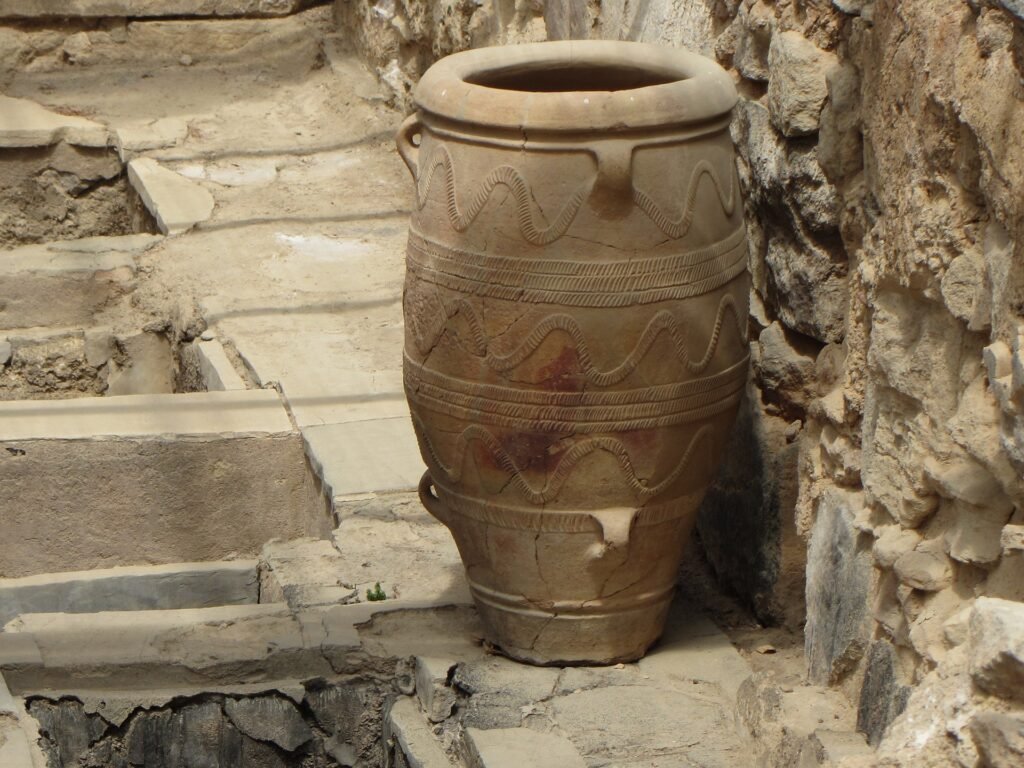
- Storage Magazines — giant clay pithoi (storage jars) still in their original positions
Best Time to Visit Knossos Palace
The site is open year-round, but the experience varies dramatically by season:
- April–May: Ideal — comfortable temperatures, fewer crowds, wildflowers in bloom
- June–August: Peak season — very hot and extremely crowded, especially 10am–3pm
- September–October: Excellent — warm, manageable crowds, golden light for photography
- November–March: Quiet and cool, some facilities may be limited
Pro tip: Arrive at opening time (8:00 AM) or in the late afternoon (after 4:00 PM) to avoid the largest tour groups.
Tickets and Opening Hours
Knossos Palace is open daily. Standard adult admission is approximately €15 (combined ticket with the Heraklion Archaeological Museum is €20 and highly recommended). Children under 5 enter free. Opening hours vary by season — generally 8:00 AM to 8:00 PM in summer, shorter in winter.
How to Get to Knossos from Heraklion
- Bus: City Bus No. 2 from Heraklion city centre — runs frequently, journey approx. 20 minutes
- Taxi: 10–15 minutes from Heraklion port or city centre, around €10–12
- Private transfer: Most comfortable option, can be arranged with hotel pickup
- Car rental: Easy parking available on site
Why Book a Private Guided Tour of Knossos
Without a guide, Knossos can be disorienting. The site is vast, the English signage is limited, and the history spans 4,000 years of civilization. A private guide transforms the experience completely:
- In-depth storytelling about Minoan civilization, mythology, and daily life
- Access to areas and insights not available to self-guided visitors
- Flexible pace — spend more time where you are most interested
- Hotel pickup and drop-off included with our private tours
- Combination with Heraklion Archaeological Museum for the full Minoan experience
Combine Knossos with the Heraklion Archaeological Museum
The Heraklion Archaeological Museum holds the world’s finest collection of Minoan art and artifacts — including the original frescoes from Knossos. A combined visit is strongly recommended. Allow a full day for both sites.
Frequently Asked Questions
How long does a visit to Knossos take?
Self-guided: 1.5–2 hours. With a private guide: 2–3 hours. Combined with the Heraklion museum: a full day.
Is Knossos suitable for children?
Yes — the mythology of the Minotaur captivates children. A private guide who specializes in family tours makes the experience even more engaging.
Can I take photos at Knossos?
Yes, photography is permitted throughout the site.
Is the site accessible for visitors with mobility limitations?
Partially — the main areas are accessible, but some sections involve uneven ground. Contact us for accessibility advice.
What should I wear to Knossos?
Comfortable walking shoes are essential. In summer, bring a hat, sunscreen, and water — there is limited shade on site.
Book a private Knossos tour | Explore all Crete experiences
Knossos Palace: Practical Visitor Information 2026
| Detail | Information |
|---|---|
| Opening hours | Summer (Apr–Oct): 08:00–20:00 | Winter (Nov–Mar): 08:00–15:00 |
| Admission | €15 (standard) | €8 (reduced: students, seniors 65+) | Under 6: free |
| Combined ticket | €20 — includes Heraklion Archaeological Museum (valid 3 days) |
| Distance from Heraklion | 5 km south of city centre (15 min by taxi, 20 min by bus no. 2) |
| Visit duration | 90 minutes (self-guided) | 2.5 hours (with private guide) |
| Best arrival time | 08:00–09:30 (before tour buses) or 16:00+ (crowds thin out) |
| Facilities | Toilets, gift shop, cafe near entrance, shaded seating areas |
The Controversy: Was Arthur Evans Right?
Knossos is one of the most debated archaeological sites in the world. Arthur Evans, who excavated the site from 1900, also reconstructed significant portions of it — adding reinforced concrete columns, repainting frescoes based on fragments, and rebuilding rooms based on his own interpretation of Minoan life. Many archaeologists have since argued that Evans's reconstruction reflects early 20th-century assumptions rather than Bronze Age reality.
The opposing view: without the reconstruction, Knossos would be a field of broken stones that most visitors could not interpret. The restored sections — the throne room, the Queen's megaron, the Grand Staircase — allow millions of people to understand and connect with a 3,500-year-old civilisation. The originals of all major frescoes are in the Heraklion Archaeological Museum; what you see at Knossos are period-accurate replicas.
The honest answer: visit Knossos with a good guide who can explain both what we know and what Evans assumed. The site is extraordinary either way.
What to See After Knossos: The Archaeological Museum
The Heraklion Archaeological Museum houses the originals of every major fresco from Knossos, plus objects from every Minoan site in Crete. The Bull-Leaping Fresco, the Dolphin Fresco, the Lily Prince — all here, displayed in rooms designed specifically for them. The museum is 5 km from the palace and shares a combined ticket (€20 covers both, valid 3 days). If you are visiting Knossos with a private guide, we typically include the museum in the same half-day.
Frequently Asked Questions
Do I need a guide at Knossos?
Not obligatory — but the difference is significant. Without a guide, Knossos is an impressive ruin. With a guide who knows Minoan history, it becomes the story of Europe's first advanced civilisation: how they built without mortar, how their plumbing worked, what the bull-leaping rituals meant, and why the palace was abandoned around 1450 BC. We offer private Knossos tours that also cover the Archaeological Museum.
How much time should I budget for Knossos?
90 minutes minimum for self-guided. 2.5 hours with a private guide. If you are combining with the Archaeological Museum (recommended), budget a full morning: 4–5 hours total.
Is Knossos suitable for children?
Yes — particularly for children aged 8 and above who can engage with the story. The scale of the ruins, the colourful frescoes, and the labyrinth mythology (Minotaur, Theseus) tend to capture children's imagination strongly. Younger children may find a 90-minute site visit tiring in summer heat. We recommend visiting in the morning.
Book a Private Knossos Tour — WhatsApp
