
Crete is the birthplace of Europe’s first advanced civilisation. The Minoans flourished for over a thousand years before collapsing mysteriously around 1450 BC, leaving behind palaces, art, and artefacts of astonishing sophistication. This guide introduces their world and tells you where to find it.
Who Were the Minoans?
The Minoans were a Bronze Age civilisation that dominated the eastern Mediterranean from roughly 2700–1450 BC. They were named after the legendary King Minos of Knossos by British archaeologist Arthur Evans, who excavated Knossos at the start of the 20th century.
Recent DNA analysis confirms the Minoans were distinct from both mainland Greeks and Egyptians — they appear to have been indigenous to Crete, descended from Neolithic farmers who arrived around 7000 BC. Their language, known as Linear A, has never been deciphered.
What Made the Minoans Remarkable?
By the standards of their time, the Minoans were extraordinarily advanced:
- Architecture: Multi-storey palaces with running water, drainage systems, and light wells — engineering not seen again in Europe for 3,000 years.
- Art: Vibrant frescoes depicting nature, sports (bull-leaping), processions, and marine life — some of the most joyful art in the ancient world.
- Trade: A maritime trading empire that reached Egypt, the Levant, Anatolia, and mainland Greece.
- Society: Evidence suggests Minoan society was relatively egalitarian and possibly matriarchal — unusually so for the ancient world.
- Religion: A goddess-centred spirituality focused on nature, fertility, and sacred caves in the mountains.
The Minoan Palaces
The great Minoan palaces were not just royal residences — they were economic, administrative, and religious centres. At least four major palaces are known:
Knossos
The largest and most famous, Knossos covers 20,000 square metres and once supported a city of 80,000–100,000 people. Arthur Evans’ controversial reconstruction gives visitors a vivid sense of scale and colour, though scholars continue to debate the accuracy of his interpretations. Knossos is 5 km from Heraklion — essential for any visitor to Crete.
Phaistos
The second-largest Minoan palace, Phaistos stands on a high ridge with breathtaking views across the Messara plain towards the White Mountains. Unlike Knossos, it has not been reconstructed — you see the ruins as found, which many visitors prefer. Phaistos is also where the famous Phaistos Disc was found in 1908: a clay disc covered in undeciphered symbols that remains one of archaeology’s greatest mysteries.
Malia
East of Heraklion on the north coast, the Malia palace complex includes a large rectangular court and one of the best-preserved Minoan storerooms on the island. Less visited than Knossos, which makes for a quieter and sometimes more atmospheric experience.
Zakros
The easternmost palace, Zakros, was a major port and trading centre. It was abandoned suddenly around 1450 BC and never reoccupied — which means archaeologists found treasure troves of intact objects, including imported materials from Egypt and the Levant. The surrounding Zakros Gorge (the “Valley of the Dead”) is also one of Crete’s best hikes.
The Heraklion Archaeological Museum
If the palaces are Crete’s open-air museums, the Heraklion Archaeological Museum is the indoors collection. It holds the greatest collection of Minoan artefacts in the world, including:
- The frescoes from Knossos — Bull-Leaper, Blue Ladies, Prince of Lilies
- The Phaistos Disc
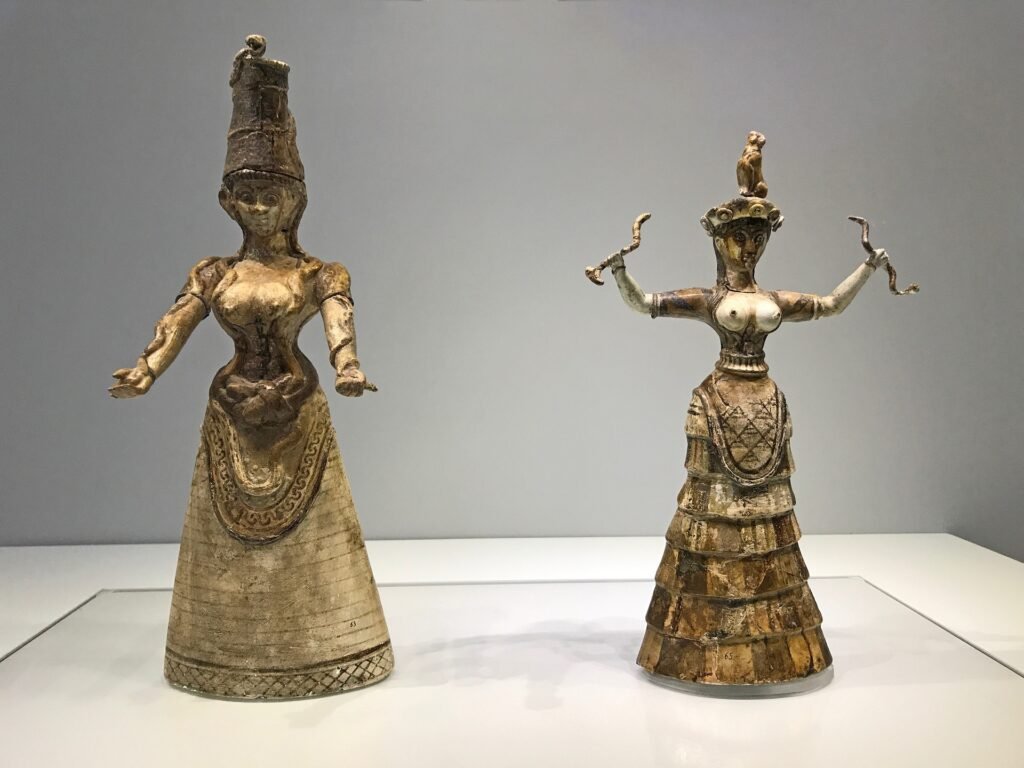
- The Snake Goddess figurines
- Minoan gold jewellery of extraordinary delicacy
- The Harvester Vase and the Boxers Rhyton
Allow at least 2–3 hours. The museum was completely renovated in 2014 and the presentation is excellent. Entry costs €15 (includes Knossos on the same day if combined with a €16 combined ticket).
The Collapse of Minoan Civilization
Around 1450 BC, virtually every Minoan palace except Knossos was destroyed, seemingly simultaneously. The cause remains debated. Leading theories:
- Mycenaean invasion: Mainland Greek (Mycenaean) warriors conquered the weakened Minoans. Evidence: Knossos was reoccupied in the Mycenaean style after the destruction.
- Thera volcanic eruption: The catastrophic eruption of the Thera (Santorini) volcano around 1628 BC caused tsunamis, crop failures, and instability that weakened Minoan society over generations.
- Internal unrest: Social upheaval, possibly linked to droughts or economic collapse.
Most scholars now believe a combination of factors — Thera, climate instability, and eventual Mycenaean takeover — brought the Minoan world to an end.
Visiting Minoan Sites: Practical Tips
- Combine Knossos + the Heraklion Museum in one day (they’re 5 km apart).
- Hire a guide at Knossos — the stories behind the rooms transform the experience.
- Visit Phaistos in the afternoon (fewer coach tours).
- The combined Knossos + Museum ticket saves €3.
- Comfortable shoes are essential — all sites involve uneven ground.
Private Guided Minoan Tours
105Olives offers private expert-guided tours of the Minoan sites — Knossos, Phaistos, the Archaeological Museum, and the remote eastern palaces. A private guide transforms a walk around ruins into a vivid encounter with a lost civilisation. Book a private Minoan tour.
